
Which Style of Fencing Is Most Suitable for Wirral Back Gardens
Which Style of Fencing Is Most Suitable for Wirral Back Gardens?
Choosing the right fencing for a Wirral back garden involves more than selecting a design that looks attractive. A garden fence must provide privacy, withstand changing weather, suit the style of the property and remain practical to maintain over many years.
Wirral contains a wide variety of homes and gardens, from traditional terraced properties and suburban family houses to modern developments and larger coastal homes. Some gardens are sheltered by nearby buildings and mature planting, while others are more exposed to wind and rain. This means that the most suitable fencing style can vary considerably from one property to another.
For many Wirral back gardens, professionally installed closeboard or feather-edge fencing with strong posts and gravel boards offers the best overall combination of privacy, durability and value. However, timber fence panels, composite fencing and contemporary slatted designs can also be excellent choices when they are selected for the right location.
This guide explains the main fencing options available and helps you decide which style is most suitable for your garden.
What Should a Back-Garden Fence Provide?
Before comparing different fencing styles, it is useful to consider what you need the new fence to achieve.
Most homeowners want their back-garden fencing to provide a combination of privacy, security and an attractive finish. Families may also need a safe boundary for children or pets, while keen gardeners may want fencing that supports climbing plants or provides a backdrop for borders and landscaping.
A suitable fence should complement the property without overwhelming the garden. It should also be strong enough for its location and practical to maintain.
The most important considerations include:
- The amount of privacy required
- The garden’s exposure to wind
- The condition of the ground
- The preferred appearance
- The amount of maintenance required
- Whether a matching gate is needed
- The available budget
- The expected lifespan of the installation
The best fence is not always the most expensive option. It is the one that suits the garden, property and homeowner’s priorities.
Closeboard Fencing: The Best All-Round Choice
Closeboard fencing, also known as feather-edge fencing, is one of the most suitable options for Wirral back gardens. It is strong, adaptable and provides a high level of privacy.
Unlike a standard pre-made fence panel, closeboard fencing is normally constructed using individual vertical feather-edge boards fixed to horizontal rails. Each board overlaps the next, forming a solid and continuous boundary.
This construction creates a robust fence that can be tailored to the exact dimensions of the garden. It is particularly useful where the ground is sloping, uneven or requires a made-to-measure installation.
Closeboard fencing is well suited to:
- Family back gardens
- Long boundary lines
- Properties requiring privacy
- Gardens with uneven ground
- Homes needing a secure boundary
- Exposed locations where strength is important
Because the fence is built from individual components, damaged boards can often be replaced without removing an entire section. This can make future repairs more straightforward than with some panel systems.
Closeboard fencing also has a traditional appearance that suits many styles of Wirral property. It looks natural beside lawns, patios, planting beds and timber garden buildings.
For additional durability, it can be installed with concrete posts and gravel boards. This is often one of the strongest and most practical combinations for a residential garden.
Why Concrete Posts and Gravel Boards Are Popular
The strength of a fence depends heavily on the posts supporting it. Even a high-quality panel may lean or fail if the posts are weak, shallow or deteriorating.
Concrete posts are popular because they provide a solid structure and do not rot in the same way as timber posts. They can be used with traditional fence panels or closeboard fencing.
Concrete gravel boards are positioned underneath the timber section. They help keep the wood away from direct contact with wet soil and reduce the risk of damage to the bottom of the fence.
This combination offers several practical advantages:
- Strong support for the fence
- Better protection from ground moisture
- Easier replacement of individual panels
- A tidy and level base
- Reduced contact between timber and soil
The appearance is more functional than an all-timber installation, but many homeowners consider the added durability worthwhile.
Concrete posts and gravel boards can be especially useful in gardens where an older fence has failed because of rotten posts or prolonged contact with damp ground.
Traditional Timber Fence Panels
Pre-made timber fence panels remain one of the most common choices for back gardens. They offer good privacy, are available in several designs and can usually be installed more quickly than fencing built entirely on site.
Popular panel styles include overlap panels, waney-edge panels, closeboard panels and decorative panels with trellis tops.
Standard timber panels can be a practical option for homeowners who want an affordable and familiar garden boundary. They are particularly suitable for relatively level gardens with evenly spaced posts.
The main advantages of timber fence panels include their natural appearance, wide availability and range of styles. They can also be painted or stained to coordinate with sheds, gates and other garden features.
However, their performance depends on the quality of the panels and the installation. Lightweight panels may not be the best choice for an exposed garden, particularly where they are likely to face regular pressure from strong winds.
For a stronger installation, homeowners may choose heavier closeboard panels supported by concrete posts and gravel boards.
Overlap and Waney-Edge Panels
Overlap panels are made using horizontal timber boards that overlap one another. They are often one of the more affordable fencing options and can provide a reasonable level of screening.
They are suitable for:
- Budget-conscious garden improvements
- Replacing individual damaged panels
- Rental properties
- Sheltered gardens
- Short or temporary boundary projects
Although practical, basic overlap panels are generally less substantial than closeboard fencing. They may require more frequent maintenance and may not be the preferred option for an exposed or high-security boundary.
For homeowners looking for a simple and economical replacement fence, they can still provide a neat and effective solution when properly installed.
Decorative Timber Panels
Decorative fence panels can create a more attractive and distinctive appearance. They are available with curved tops, lattice sections, trellis panels and contemporary horizontal designs.
These styles are often selected for landscaped gardens where appearance is especially important.
A decorative panel may be suitable around:
- Patios and seating areas
- Garden rooms
- Outdoor dining spaces
- Landscaped borders
- Hot-tub areas
- Feature sections of the garden
Some decorative panels provide complete privacy, while others allow light and air to pass through. A trellis-topped design can create screening without making a smaller garden feel too enclosed.
Decorative panels may cost more than basic fencing, and their more detailed construction can sometimes make repairs more complicated. Their suitability will also depend on how exposed the garden is.
Composite Fencing: A Low-Maintenance Alternative
Composite fencing is an increasingly popular option for homeowners who want a modern appearance with less routine maintenance than timber.
Composite boards are designed to provide a consistent finish and are available in a range of colours. They can coordinate particularly well with composite decking, porcelain paving, rendered walls and modern garden rooms.
Composite fencing may be suitable for:
- Contemporary gardens
- Low-maintenance properties
- Outdoor entertaining areas
- Homes with composite decking
- Garden renovations with a coordinated design
- Homeowners who do not want to repaint or stain fencing regularly
One of its main attractions is its consistent appearance. Unlike natural timber, composite boards do not have the same variations in grain, knots and colour.
The initial cost is usually higher than basic timber fencing, but some homeowners consider the reduced maintenance and modern finish to be good long-term value.
Correct installation is essential. Composite systems need suitable posts, secure fixings and adequate support. A poorly fitted system may move, bow or become misaligned.
Composite fencing can be an excellent option for a modern Wirral garden, although closeboard timber may still be preferable where maximum structural strength or a traditional appearance is required.
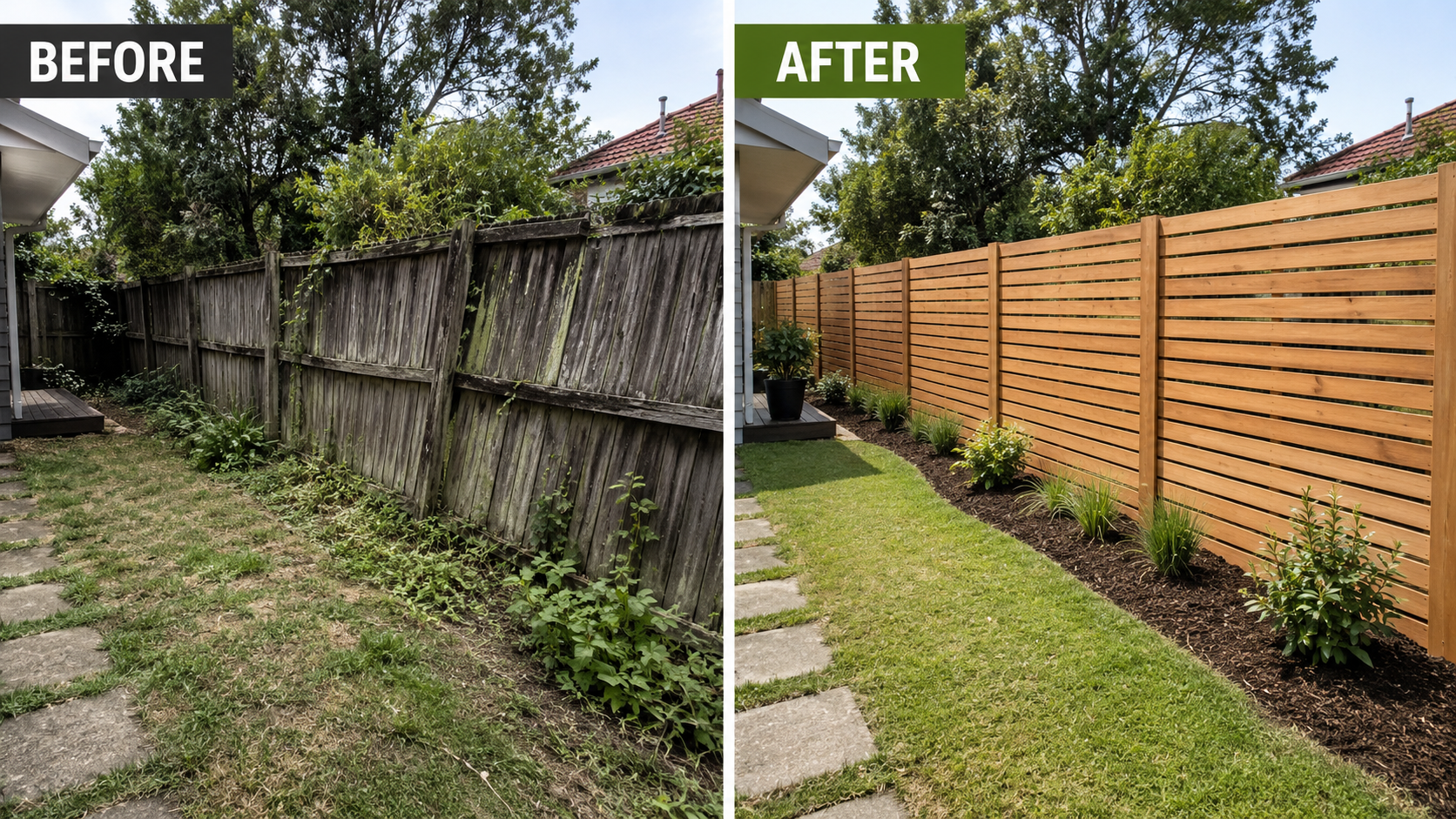
Horizontal Slatted Fencing
Horizontal slatted fencing has become popular in contemporary garden design. Instead of using vertical boards, timber or composite slats are installed horizontally to create clean, modern lines.
The gaps between the slats can be adjusted depending on the required level of privacy. Closely spaced slats provide better screening, while larger gaps allow more light and airflow.
Horizontal slatted fencing works particularly well alongside:
- Modern extensions
- Garden rooms
- Composite decking
- Porcelain patios
- Outdoor kitchens
- Contemporary planting
- Rendered raised beds
This style can make a garden feel wider because the horizontal lines draw the eye across the space. It is often used as a feature wall behind seating or dining areas.
However, a slatted fence needs a strong support structure. Long horizontal boards may move or warp if they are not installed correctly.
In very exposed locations, some airflow between the boards can reduce wind pressure, but the posts and framework must still be secure.
Horizontal slatted fencing is best for homeowners who prioritise appearance and are prepared to invest in careful installation and suitable materials.
Trellis Fencing and Trellis-Topped Panels
Trellis is a useful option for homeowners who want a softer and more decorative garden boundary.
It can be installed as a complete lightweight screen or added above a solid fence panel. Trellis allows light through while providing support for climbing plants.
It is particularly useful for:
- Increasing screening around seating areas
- Adding height without using another solid section
- Supporting roses, clematis and other climbers
- Concealing bins or storage areas
- Dividing different sections of the garden
- Creating a decorative backdrop
A solid lower section with trellis above can provide a good balance between privacy and openness. It can make the garden feel less enclosed than a completely solid fence.
Trellis is not usually suitable as the main security boundary unless it is combined with a stronger fencing system. It should also be checked regularly when supporting heavy plants, as overgrown vegetation can place pressure on the structure.
Picket Fencing
Picket fencing is attractive and traditional, but it is generally more suitable for front gardens or internal garden divisions than for a main back-garden boundary.
The gaps between the boards allow visibility and light, which means picket fencing provides very little privacy.
It can still be useful for:
- Separating a lawn from a play area
- Creating a boundary around a vegetable garden
- Defining a pathway
- Enclosing a small pet area
- Adding a cottage-style feature
- Dividing a larger garden
For most Wirral back gardens, picket fencing would not be the first choice for the outer boundary. However, it can be an attractive secondary feature within the garden.
Timber Posts or Concrete Posts?
Both timber and concrete posts can be suitable, but they provide different benefits.
Timber posts offer a completely natural appearance. They coordinate well with timber panels and may be preferred for decorative or traditional installations.
Pressure-treated timber posts can provide good performance when correctly installed. However, the section below ground is exposed to moisture and may eventually deteriorate.
Concrete posts provide a more durable and functional support system. They are heavier and require careful installation, but they can offer greater resistance to rot and make future panel replacement easier.
Timber posts may be preferable when:
- Appearance is the main priority
- The garden is sheltered
- A natural all-timber finish is desired
- The fencing is decorative or relatively low
Concrete posts may be preferable when:
- Long-term durability is important
- The garden is exposed
- Previous timber posts have rotted
- Heavy panels are being installed
- Easy panel replacement is desirable
The decision should be based on the garden’s conditions as well as appearance.
Choosing Fencing for Exposed Wirral Gardens
Some Wirral gardens are more exposed than others. Homes near open spaces, elevated locations or coastal areas may experience stronger wind than sheltered residential streets.
A large solid fence acts like a barrier against the wind. This places considerable force on the panels, posts and foundations.
For exposed gardens, the quality of installation is particularly important. Strong posts, suitable foundations and secure fixings are essential.
Closeboard fencing with substantial posts is often a reliable option. Slatted fencing may also be considered because the gaps allow some airflow, although the overall frame still needs to be strong.
Lightweight or poorly supported panels may not be suitable for exposed boundaries.
A professional installer should assess:
- The direction of the prevailing wind
- The length and height of the fence
- The condition of the ground
- The spacing of the posts
- The weight and style of the panels
- Nearby walls, buildings and trees
The strongest fencing style can still fail when the foundations are inadequate.
Fencing for Privacy
Privacy is one of the main reasons Wirral homeowners replace their back-garden fencing.
Solid closeboard fencing, heavy timber panels and composite systems can all provide effective screening.
The most suitable option will depend on the size of the garden. A very tall, dark fence can make a small space feel enclosed, while a lighter timber finish may help the garden feel brighter.
Privacy can also be improved around specific areas rather than along the whole boundary. For example, a slatted screen or trellis section may be positioned around a patio, hot tub or outdoor dining space.
Homeowners should check any applicable restrictions or permissions before changing the height or position of a boundary fence.
Fencing for Security
A secure fence should be stable, difficult to climb and free from loose or damaged sections.
Solid closeboard fencing can create a strong visual and physical boundary. Composite systems may also provide effective security when they are professionally installed.
The gate should be considered part of the same system. A strong fence provides limited security if the gate has weak hinges, a loose frame or an unreliable latch.
A secure installation should include:
- Strong posts
- Secure panels or boards
- Reliable fixings
- A properly supported gate
- Suitable hinges and latches
- No unnecessary gaps at ground level
- Prompt repairs when damage occurs
Security should be balanced with visibility around entrances and pathways.
Fencing for Children and Pets
Families may need fencing that creates a safe and enclosed outdoor space.
A solid fence can help prevent children and animals from leaving the garden. It may also reduce visual distractions for dogs that react to people or animals outside the boundary.
Closeboard, timber panel and composite fencing can all be suitable, provided they are installed securely.
Particular attention should be given to:
- Gaps underneath panels
- Spaces beside posts
- Gate latches
- Sharp or exposed fixings
- Loose boards
- Climbable objects positioned beside the fence
- Damaged sections that could create an escape route
The needs of the household should be discussed before selecting the fence height and construction.
Matching the Fence to the Property
The fencing should complement the style of the house and the rest of the garden.
Traditional homes often suit natural timber, closeboard fencing and decorative trellis. Modern homes may be enhanced by horizontal slats, composite boards or darker contemporary finishes.
The fence should also coordinate with other garden features, including:
- Decking
- Paving
- Garden buildings
- Gates
- Exterior paintwork
- Raised beds
- Pergolas
- Outdoor furniture
A consistent design can make the whole garden feel more organised and professionally finished.
Natural timber provides a warm and versatile backdrop for planting. Dark fencing can make bright flowers and green foliage stand out, while lighter fencing may help a compact garden appear more spacious.
Maintenance Requirements
Every fencing material requires some care, although the amount varies.
Timber fencing may need periodic treatment to maintain its appearance and protect the surface. Damaged boards and loose fixings should be repaired promptly.
Composite fencing generally requires less maintenance, although it may still need occasional cleaning.
Concrete posts and gravel boards usually need very little routine attention, but they should still be checked for movement or damage.
Regularly removing heavy vegetation from the fence can also reduce pressure and improve airflow. Soil and garden waste should not be allowed to build up against timber panels.
A small amount of regular maintenance can help prevent minor problems from becoming major repairs.
Repair or Full Replacement?
A complete replacement is not always necessary. One damaged panel or broken board may be repairable.
Repairs may be suitable when:
- Most of the fence is still structurally sound
- Only one or two panels are damaged
- The posts remain secure
- The fence is relatively new
- The damage is localised
Full replacement may be more practical when:
- Several posts are leaning or rotten
- Multiple panels are damaged
- The fence has become uneven
- Repairs are becoming frequent
- Privacy or security is no longer adequate
- The existing design no longer suits the property
- A new gate and complete boundary are required
Replacing the whole fence creates a consistent appearance and allows the installation to be designed as a complete system.
Which Fencing Style Is Best for Most Wirral Back Gardens?
For many Wirral properties, closeboard or feather-edge fencing with concrete posts and gravel boards is the strongest all-round choice.
It provides good privacy, suits traditional and modern gardens, can be adapted to uneven ground and is relatively straightforward to repair. When professionally installed, it creates a secure and substantial boundary.
Heavy-duty timber fence panels with concrete posts are another practical option, particularly when homeowners want a quicker installation and the ability to replace individual panels.
Composite fencing is ideal for customers who want a low-maintenance, contemporary appearance and are prepared for a higher initial investment.
Horizontal slatted fencing is best suited to modern garden designs, feature areas and homeowners who prioritise a distinctive appearance.
Decorative and trellis-topped panels can be excellent for sheltered gardens where light, planting and visual appeal are more important than maximum strength.
Professional Fencing Installation Across Wirral
The quality of the installation is just as important as the fencing material.
Accurate measurements, secure posts, correct spacing and suitable foundations all contribute to the performance of the finished fence. The ground, garden layout and level of exposure should be assessed before work begins.
Merseyside Fencing provides professional garden fencing and gate installation throughout Wirral. We can assess your existing boundary, discuss suitable fencing styles and recommend an installation based on your garden, property and budget.
Whether you need traditional timber panels, closeboard fencing, concrete posts, gravel boards or a complete new garden boundary, a professionally installed fence can improve privacy, security and the overall appearance of your outdoor space.
Contact Merseyside Fencing to arrange a quotation and discuss the most suitable fencing style for your Wirral back garden.