
How High Can a Back Garden Fence Legally Be on the Wirral?
Suggested URL:merseysidefencing.uk/garden-fence-height-rules-wirral/
Primary keyword: garden fence height Wirral
Meta title: How High Can a Back Garden Fence Legally Be on the Wirral?
Suggested URL:merseysidefencing.uk/garden-fence-height-rules-wirral/
Primary keyword: garden fence height Wirral
Meta title: How High Can a Garden Fence Be on the Wirral?
Meta description: Learn the legal height limits for rear and side garden fences on the Wirral, including boundaries with neighbours, roads and open land.
What Is the Legal Height for a Garden Fence on the Wirral?
Many homeowners want a taller garden fence for privacy, security or to create a safer space for children and pets. However, before installing new fencing, it is important to understand when planning permission may be required.
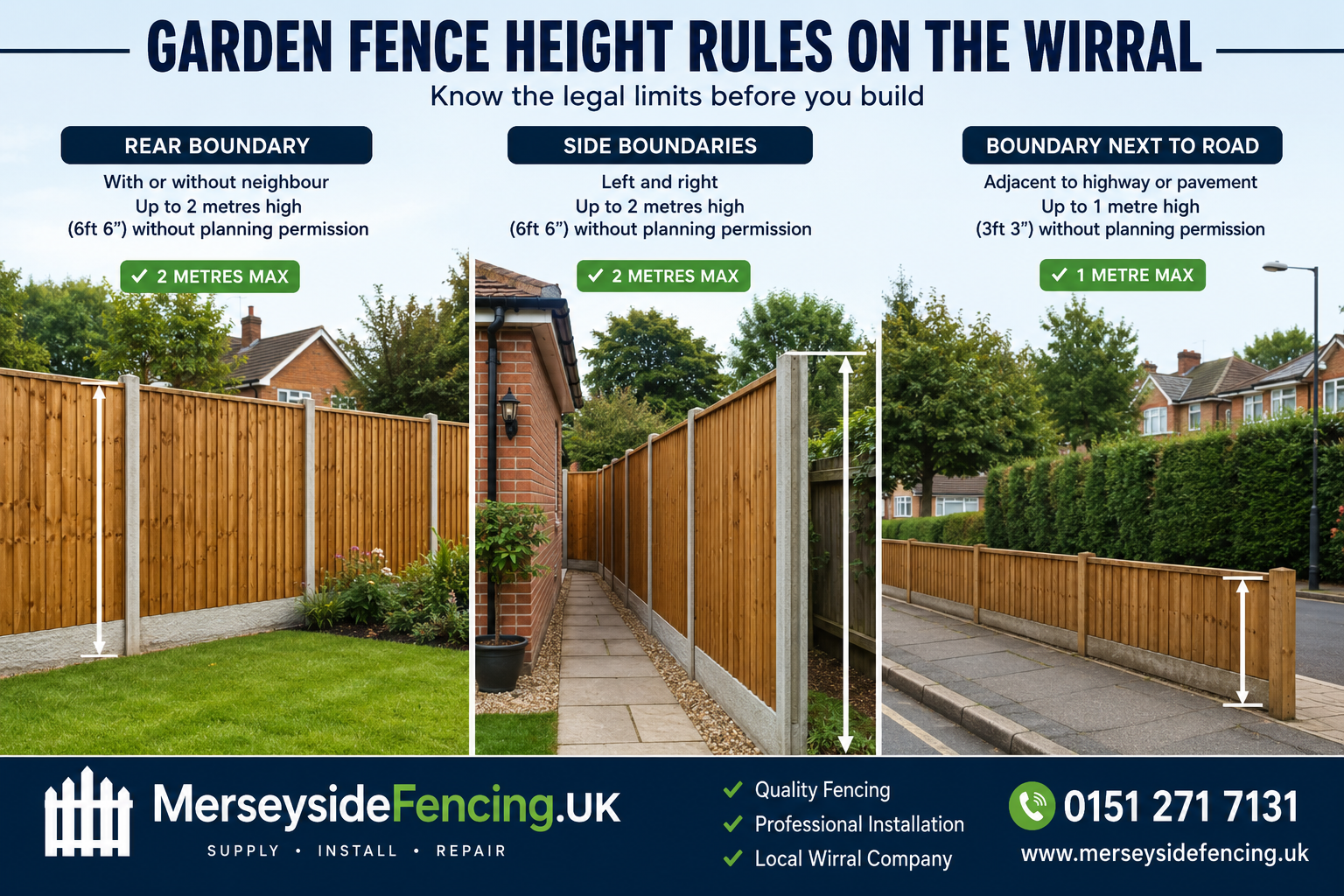
For most homes on the Wirral, a rear or side garden fence can be up to two metres high from ground level without applying for planning permission.
When a fence is next to a road used by vehicles—or the pavement alongside that road—the permitted height is normally reduced to one metre. A higher fence may still be possible, but planning permission would usually be required. (Planning Portal)
These are permitted-development limits rather than absolute maximum heights. A fence over two metres is not automatically prohibited, but it generally needs approval from Wirral Council before it is installed.
How High Can a Rear Garden Fence Be?
A typical rear boundary fence can usually be installed up to two metres, approximately 6 feet 6 inches, without planning permission.
This normally applies whether the boundary backs onto:
- Another residential garden
- Private land
- A field
- Woodland
- Commercial property
- An unused or undeveloped area
The presence or absence of a neighbouring house does not normally change the two-metre planning limit.
However, the position of the boundary still matters. A rear fence adjoining a road used by vehicles, or its pavement, will normally be limited to one metre without planning permission. (Planning Portal)
Where a rear garden backs onto an alley, access road or public route, homeowners should check how that route is legally classified. If it forms part of a highway used by vehicles, the lower one-metre limit may apply.
What If There Is a Neighbour Behind the Property?
Having a bordering neighbour does not reduce the normal two-metre permitted-development height.
You may usually install a fence up to two metres high without planning permission, provided that:
- The fence is on your land
- No special planning restriction applies
- The property is not affected by listed-building rules
- The permitted-development right has not been removed
- The fence is not beside a road or pavement where the one-metre rule applies
Although planning permission may not be necessary, it is sensible to discuss the work with the neighbouring property owner before replacing a shared or existing boundary fence.
You should not remove, alter or attach fencing to a structure belonging to your neighbour without their permission.
What If There Is No Neighbour Behind the Property?
The normal limit remains two metres merely because there is no residential neighbour behind the garden.
For example, a property backing onto private open land will not automatically be allowed a taller fence. Equally, the absence of a neighbour does not normally mean the fence must be lower.
Different rules or permissions could still apply if the rear boundary adjoins:
- A road or pavement
- Council-owned land
- A railway
- A public access route
- Protected land
- A listed property
- A conservation area
The ownership of the land behind the garden should also be established before access is taken through it or fencing work is carried out from the other side.
How High Can Left and Right Boundary Fences Be?
The usual permitted height for both left-hand and right-hand garden boundaries is two metres from ground level.
There is no general planning rule stating that the left fence must be a different height from the right fence.
The same limit normally applies whether:
- Both sides have neighbouring properties
- Only one side has a neighbour
- One side borders open land
- The property is detached
- The property is semi-detached
- The property is terraced
The important exception is a side boundary adjacent to a road used by vehicles or its pavement. In that position, a fence above one metre will normally require planning permission. (Planning Portal)
This can be particularly relevant to corner properties, where a side garden runs alongside a road.
Do You Need Your Neighbour’s Permission?
You do not normally require your neighbour’s permission to install a lawful fence completely inside your own boundary.
However, you may need their agreement where:
- The existing fence belongs to them
- The precise boundary is uncertain
- Posts or foundations would enter their land
- You need access to their garden
- The title deeds contain shared-maintenance obligations
- The fence is genuinely shared
HM Land Registry explains that title plans generally show only the approximate extent of a property. They frequently do not establish the exact boundary or identify who owns a particular fence, hedge or wall. (GOV.UK)
Where responsibility is unclear, check the title register, title plan, original transfer documents and any available deeds. Neighbours can also make a written boundary agreement recording the position of the boundary and responsibility for maintaining the fence. (GOV.UK)
Does Trellis Count Towards the Fence Height?
Homeowners should treat the entire structure as part of its overall height. This includes:
- Gravel boards
- Fence panels
- Concrete or timber bases
- Trellis
- Decorative screening
- A fence installed on top of a wall
Do not assume that adding trellis above a two-metre fence is automatically permitted. If the complete structure exceeds two metres, obtain confirmation from Wirral Council before installation.
On sloping or stepped land, measuring the height can be more complicated. Professional planning advice may be appropriate where ground levels vary significantly.
When Might Planning Permission Be Required?
Planning permission will normally be needed when a new fence would be:
- More than two metres high away from a road
- More than one metre high beside a road or its pavement
- Affected by an Article 4 direction
- Restricted by a condition attached to an earlier planning approval
- Within the grounds of a listed building
- On a boundary with a neighbouring listed building or its grounds
Additional controls can also apply when removing certain walls or fences in conservation areas. (Planning Portal)
A restrictive covenant, lease or estate rule can apply separately from planning law. A fence might not require planning permission but could still need consent from a landlord, management company or another party.
How Can You Get Formal Confirmation?
For straightforward domestic fencing, the two-metre and one-metre rules provide a useful starting point. However, unusual sites and properties with planning restrictions should be checked individually.
Wirral Council advises that homeowners can apply for a Lawful Development Certificate when they want formal confirmation that proposed work does not require planning permission. The resulting decision notice is a legal document and is recorded on the planning register. (Wirral Council)
Professional Garden Fencing Across the Wirral
Merseyside Fencing supplies and installs attractive, secure and durable fencing throughout the Wirral.
Whether you need to replace storm-damaged panels, improve garden privacy or install an entirely new boundary fence, we can help you select a suitable design and height for your property.
Contact MerseysideFencing.UK for a free fencing quotation.
Important legal note
This article provides general information about planning rules in England and is not legal or property-boundary advice. Planning restrictions, title conditions and site circumstances can differ. Homeowners should obtain advice from Wirral Council or a qualified property professional where there is any uncertainty.
Last reviewed: July 2026.
Meta description: Learn the legal height limits for rear and side garden fences on the Wirral, including boundaries with neighbours, roads and open land.
What Is the Legal Height for a Garden Fence on the Wirral?
Many homeowners want a taller garden fence for privacy, security or to create a safer space for children and pets. However, before installing new fencing, it is important to understand when planning permission may be required.
For most homes on the Wirral, a rear or side garden fence can be up to two metres high from ground level without applying for planning permission.
When a fence is next to a road used by vehicles—or the pavement alongside that road—the permitted height is normally reduced to one metre. A higher fence may still be possible, but planning permission would usually be required. (Planning Portal)
These are permitted-development limits rather than absolute maximum heights. A fence over two metres is not automatically prohibited, but it generally needs approval from Wirral Council before it is installed.
How High Can a Rear Garden Fence Be?
A typical rear boundary fence can usually be installed up to two metres, approximately 6 feet 6 inches, without planning permission.
This normally applies whether the boundary backs onto:
- Another residential garden
- Private land
- A field
- Woodland
- Commercial property
- An unused or undeveloped area
The presence or absence of a neighbouring house does not normally change the two-metre planning limit.
However, the position of the boundary still matters. A rear fence adjoining a road used by vehicles, or its pavement, will normally be limited to one metre without planning permission. (Planning Portal)
Where a rear garden backs onto an alley, access road or public route, homeowners should check how that route is legally classified. If it forms part of a highway used by vehicles, the lower one-metre limit may apply.
What If There Is a Neighbour Behind the Property?
Having a bordering neighbour does not reduce the normal two-metre permitted-development height.
You may usually install a fence up to two metres high without planning permission, provided that:
- The fence is on your land
- No special planning restriction applies
- The property is not affected by listed-building rules
- The permitted-development right has not been removed
- The fence is not beside a road or pavement where the one-metre rule applies
Although planning permission may not be necessary, it is sensible to discuss the work with the neighbouring property owner before replacing a shared or existing boundary fence.
You should not remove, alter or attach fencing to a structure belonging to your neighbour without their permission.
What If There Is No Neighbour Behind the Property?
The normal limit remains two metres merely because there is no residential neighbour behind the garden.
For example, a property backing onto private open land will not automatically be allowed a taller fence. Equally, the absence of a neighbour does not normally mean the fence must be lower.
Different rules or permissions could still apply if the rear boundary adjoins:
- A road or pavement
- Council-owned land
- A railway
- A public access route
- Protected land
- A listed property
- A conservation area
The ownership of the land behind the garden should also be established before access is taken through it or fencing work is carried out from the other side.
How High Can Left and Right Boundary Fences Be?
The usual permitted height for both left-hand and right-hand garden boundaries is two metres from ground level.
There is no general planning rule stating that the left fence must be a different height from the right fence.
The same limit normally applies whether:
- Both sides have neighbouring properties
- Only one side has a neighbour
- One side borders open land
- The property is detached
- The property is semi-detached
- The property is terraced
The important exception is a side boundary adjacent to a road used by vehicles or its pavement. In that position, a fence above one metre will normally require planning permission. (Planning Portal)
This can be particularly relevant to corner properties, where a side garden runs alongside a road.
Do You Need Your Neighbour’s Permission?
You do not normally require your neighbour’s permission to install a lawful fence completely inside your own boundary.
However, you may need their agreement where:
- The existing fence belongs to them
- The precise boundary is uncertain
- Posts or foundations would enter their land
- You need access to their garden
- The title deeds contain shared-maintenance obligations
- The fence is genuinely shared
HM Land Registry explains that title plans generally show only the approximate extent of a property. They frequently do not establish the exact boundary or identify who owns a particular fence, hedge or wall. (GOV.UK)
Where responsibility is unclear, check the title register, title plan, original transfer documents and any available deeds. Neighbours can also make a written boundary agreement recording the position of the boundary and responsibility for maintaining the fence. (GOV.UK)
Does Trellis Count Towards the Fence Height?
Homeowners should treat the entire structure as part of its overall height. This includes:
- Gravel boards
- Fence panels
- Concrete or timber bases
- Trellis
- Decorative screening
- A fence installed on top of a wall
Do not assume that adding trellis above a two-metre fence is automatically permitted. If the complete structure exceeds two metres, obtain confirmation from Wirral Council before installation.
On sloping or stepped land, measuring the height can be more complicated. Professional planning advice may be appropriate where ground levels vary significantly.
When Might Planning Permission Be Required?
Planning permission will normally be needed when a new fence would be:
- More than two metres high away from a road
- More than one metre high beside a road or its pavement
- Affected by an Article 4 direction
- Restricted by a condition attached to an earlier planning approval
- Within the grounds of a listed building
- On a boundary with a neighbouring listed building or its grounds
Additional controls can also apply when removing certain walls or fences in conservation areas. (Planning Portal)
A restrictive covenant, lease or estate rule can apply separately from planning law. A fence might not require planning permission but could still need consent from a landlord, management company or another party.
How Can You Get Formal Confirmation?
For straightforward domestic fencing, the two-metre and one-metre rules provide a useful starting point. However, unusual sites and properties with planning restrictions should be checked individually.
Wirral Council advises that homeowners can apply for a Lawful Development Certificate when they want formal confirmation that proposed work does not require planning permission. The resulting decision notice is a legal document and is recorded on the planning register. (Wirral Council)
Professional Garden Fencing Across the Wirral
Merseyside Fencing supplies and installs attractive, secure and durable fencing throughout the Wirral.
Whether you need to replace storm-damaged panels, improve garden privacy or install an entirely new boundary fence, we can help you select a suitable design and height for your property.
Contact MerseysideFencing.UK for a free fencing quotation.
Important legal note
This article provides general information about planning rules in England and is not legal or property-boundary advice. Planning restrictions, title conditions and site circumstances can differ. Homeowners should obtain advice from Wirral Council or a qualified property professional where there is any uncertainty.
Last reviewed: July 2026.
How High Can a Back Garden Fence Legally Be on the Wirral?
Suggested URL:merseysidefencing.uk/garden-fence-height-rules-wirral/
Primary keyword: garden fence height Wirral
Meta title: How High Can a Back Garden Fence Legally Be on the Wirral?
Suggested URL:merseysidefencing.uk/garden-fence-height-rules-wirral/
Primary keyword: garden fence height Wirral
Meta title: How High Can a Garden Fence Be on the Wirral?
Meta description: Learn the legal height limits for rear and side garden fences on the Wirral, including boundaries with neighbours, roads and open land.
What Is the Legal Height for a Garden Fence on the Wirral?
Many homeowners want a taller garden fence for privacy, security or to create a safer space for children and pets. However, before installing new fencing, it is important to understand when planning permission may be required.
For most homes on the Wirral, a rear or side garden fence can be up to two metres high from ground level without applying for planning permission.
When a fence is next to a road used by vehicles—or the pavement alongside that road—the permitted height is normally reduced to one metre. A higher fence may still be possible, but planning permission would usually be required. (Planning Portal)
These are permitted-development limits rather than absolute maximum heights. A fence over two metres is not automatically prohibited, but it generally needs approval from Wirral Council before it is installed.
How High Can a Rear Garden Fence Be?
A typical rear boundary fence can usually be installed up to two metres, approximately 6 feet 6 inches, without planning permission.
This normally applies whether the boundary backs onto:
- Another residential garden
- Private land
- A field
- Woodland
- Commercial property
- An unused or undeveloped area
The presence or absence of a neighbouring house does not normally change the two-metre planning limit.
However, the position of the boundary still matters. A rear fence adjoining a road used by vehicles, or its pavement, will normally be limited to one metre without planning permission. (Planning Portal)
Where a rear garden backs onto an alley, access road or public route, homeowners should check how that route is legally classified. If it forms part of a highway used by vehicles, the lower one-metre limit may apply.
What If There Is a Neighbour Behind the Property?
Having a bordering neighbour does not reduce the normal two-metre permitted-development height.
You may usually install a fence up to two metres high without planning permission, provided that:
- The fence is on your land
- No special planning restriction applies
- The property is not affected by listed-building rules
- The permitted-development right has not been removed
- The fence is not beside a road or pavement where the one-metre rule applies
Although planning permission may not be necessary, it is sensible to discuss the work with the neighbouring property owner before replacing a shared or existing boundary fence.
You should not remove, alter or attach fencing to a structure belonging to your neighbour without their permission.
What If There Is No Neighbour Behind the Property?
The normal limit remains two metres merely because there is no residential neighbour behind the garden.
For example, a property backing onto private open land will not automatically be allowed a taller fence. Equally, the absence of a neighbour does not normally mean the fence must be lower.
Different rules or permissions could still apply if the rear boundary adjoins:
- A road or pavement
- Council-owned land
- A railway
- A public access route
- Protected land
- A listed property
- A conservation area
The ownership of the land behind the garden should also be established before access is taken through it or fencing work is carried out from the other side.
How High Can Left and Right Boundary Fences Be?
The usual permitted height for both left-hand and right-hand garden boundaries is two metres from ground level.
There is no general planning rule stating that the left fence must be a different height from the right fence.
The same limit normally applies whether:
- Both sides have neighbouring properties
- Only one side has a neighbour
- One side borders open land
- The property is detached
- The property is semi-detached
- The property is terraced
The important exception is a side boundary adjacent to a road used by vehicles or its pavement. In that position, a fence above one metre will normally require planning permission. (Planning Portal)
This can be particularly relevant to corner properties, where a side garden runs alongside a road.
Do You Need Your Neighbour’s Permission?
You do not normally require your neighbour’s permission to install a lawful fence completely inside your own boundary.
However, you may need their agreement where:
- The existing fence belongs to them
- The precise boundary is uncertain
- Posts or foundations would enter their land
- You need access to their garden
- The title deeds contain shared-maintenance obligations
- The fence is genuinely shared
HM Land Registry explains that title plans generally show only the approximate extent of a property. They frequently do not establish the exact boundary or identify who owns a particular fence, hedge or wall. (GOV.UK)
Where responsibility is unclear, check the title register, title plan, original transfer documents and any available deeds. Neighbours can also make a written boundary agreement recording the position of the boundary and responsibility for maintaining the fence. (GOV.UK)
Does Trellis Count Towards the Fence Height?
Homeowners should treat the entire structure as part of its overall height. This includes:
- Gravel boards
- Fence panels
- Concrete or timber bases
- Trellis
- Decorative screening
- A fence installed on top of a wall
Do not assume that adding trellis above a two-metre fence is automatically permitted. If the complete structure exceeds two metres, obtain confirmation from Wirral Council before installation.
On sloping or stepped land, measuring the height can be more complicated. Professional planning advice may be appropriate where ground levels vary significantly.
When Might Planning Permission Be Required?
Planning permission will normally be needed when a new fence would be:
- More than two metres high away from a road
- More than one metre high beside a road or its pavement
- Affected by an Article 4 direction
- Restricted by a condition attached to an earlier planning approval
- Within the grounds of a listed building
- On a boundary with a neighbouring listed building or its grounds
Additional controls can also apply when removing certain walls or fences in conservation areas. (Planning Portal)
A restrictive covenant, lease or estate rule can apply separately from planning law. A fence might not require planning permission but could still need consent from a landlord, management company or another party.
How Can You Get Formal Confirmation?
For straightforward domestic fencing, the two-metre and one-metre rules provide a useful starting point. However, unusual sites and properties with planning restrictions should be checked individually.
Wirral Council advises that homeowners can apply for a Lawful Development Certificate when they want formal confirmation that proposed work does not require planning permission. The resulting decision notice is a legal document and is recorded on the planning register. (Wirral Council)
Professional Garden Fencing Across the Wirral
Merseyside Fencing supplies and installs attractive, secure and durable fencing throughout the Wirral.
Whether you need to replace storm-damaged panels, improve garden privacy or install an entirely new boundary fence, we can help you select a suitable design and height for your property.
Contact MerseysideFencing.UK for a free fencing quotation.
Important legal note
This article provides general information about planning rules in England and is not legal or property-boundary advice. Planning restrictions, title conditions and site circumstances can differ. Homeowners should obtain advice from Wirral Council or a qualified property professional where there is any uncertainty.
Last reviewed: July 2026.
Meta description: Learn the legal height limits for rear and side garden fences on the Wirral, including boundaries with neighbours, roads and open land.
What Is the Legal Height for a Garden Fence on the Wirral?
Many homeowners want a taller garden fence for privacy, security or to create a safer space for children and pets. However, before installing new fencing, it is important to understand when planning permission may be required.
For most homes on the Wirral, a rear or side garden fence can be up to two metres high from ground level without applying for planning permission.
When a fence is next to a road used by vehicles—or the pavement alongside that road—the permitted height is normally reduced to one metre. A higher fence may still be possible, but planning permission would usually be required. (Planning Portal)
These are permitted-development limits rather than absolute maximum heights. A fence over two metres is not automatically prohibited, but it generally needs approval from Wirral Council before it is installed.
How High Can a Rear Garden Fence Be?
A typical rear boundary fence can usually be installed up to two metres, approximately 6 feet 6 inches, without planning permission.
This normally applies whether the boundary backs onto:
- Another residential garden
- Private land
- A field
- Woodland
- Commercial property
- An unused or undeveloped area
The presence or absence of a neighbouring house does not normally change the two-metre planning limit.
However, the position of the boundary still matters. A rear fence adjoining a road used by vehicles, or its pavement, will normally be limited to one metre without planning permission. (Planning Portal)
Where a rear garden backs onto an alley, access road or public route, homeowners should check how that route is legally classified. If it forms part of a highway used by vehicles, the lower one-metre limit may apply.
What If There Is a Neighbour Behind the Property?
Having a bordering neighbour does not reduce the normal two-metre permitted-development height.
You may usually install a fence up to two metres high without planning permission, provided that:
- The fence is on your land
- No special planning restriction applies
- The property is not affected by listed-building rules
- The permitted-development right has not been removed
- The fence is not beside a road or pavement where the one-metre rule applies
Although planning permission may not be necessary, it is sensible to discuss the work with the neighbouring property owner before replacing a shared or existing boundary fence.
You should not remove, alter or attach fencing to a structure belonging to your neighbour without their permission.
What If There Is No Neighbour Behind the Property?
The normal limit remains two metres merely because there is no residential neighbour behind the garden.
For example, a property backing onto private open land will not automatically be allowed a taller fence. Equally, the absence of a neighbour does not normally mean the fence must be lower.
Different rules or permissions could still apply if the rear boundary adjoins:
- A road or pavement
- Council-owned land
- A railway
- A public access route
- Protected land
- A listed property
- A conservation area
The ownership of the land behind the garden should also be established before access is taken through it or fencing work is carried out from the other side.
How High Can Left and Right Boundary Fences Be?
The usual permitted height for both left-hand and right-hand garden boundaries is two metres from ground level.
There is no general planning rule stating that the left fence must be a different height from the right fence.
The same limit normally applies whether:
- Both sides have neighbouring properties
- Only one side has a neighbour
- One side borders open land
- The property is detached
- The property is semi-detached
- The property is terraced
The important exception is a side boundary adjacent to a road used by vehicles or its pavement. In that position, a fence above one metre will normally require planning permission. (Planning Portal)
This can be particularly relevant to corner properties, where a side garden runs alongside a road.
Do You Need Your Neighbour’s Permission?
You do not normally require your neighbour’s permission to install a lawful fence completely inside your own boundary.
However, you may need their agreement where:
- The existing fence belongs to them
- The precise boundary is uncertain
- Posts or foundations would enter their land
- You need access to their garden
- The title deeds contain shared-maintenance obligations
- The fence is genuinely shared
HM Land Registry explains that title plans generally show only the approximate extent of a property. They frequently do not establish the exact boundary or identify who owns a particular fence, hedge or wall. (GOV.UK)
Where responsibility is unclear, check the title register, title plan, original transfer documents and any available deeds. Neighbours can also make a written boundary agreement recording the position of the boundary and responsibility for maintaining the fence. (GOV.UK)
Does Trellis Count Towards the Fence Height?
Homeowners should treat the entire structure as part of its overall height. This includes:
- Gravel boards
- Fence panels
- Concrete or timber bases
- Trellis
- Decorative screening
- A fence installed on top of a wall
Do not assume that adding trellis above a two-metre fence is automatically permitted. If the complete structure exceeds two metres, obtain confirmation from Wirral Council before installation.
On sloping or stepped land, measuring the height can be more complicated. Professional planning advice may be appropriate where ground levels vary significantly.
When Might Planning Permission Be Required?
Planning permission will normally be needed when a new fence would be:
- More than two metres high away from a road
- More than one metre high beside a road or its pavement
- Affected by an Article 4 direction
- Restricted by a condition attached to an earlier planning approval
- Within the grounds of a listed building
- On a boundary with a neighbouring listed building or its grounds
Additional controls can also apply when removing certain walls or fences in conservation areas. (Planning Portal)
A restrictive covenant, lease or estate rule can apply separately from planning law. A fence might not require planning permission but could still need consent from a landlord, management company or another party.
How Can You Get Formal Confirmation?
For straightforward domestic fencing, the two-metre and one-metre rules provide a useful starting point. However, unusual sites and properties with planning restrictions should be checked individually.
Wirral Council advises that homeowners can apply for a Lawful Development Certificate when they want formal confirmation that proposed work does not require planning permission. The resulting decision notice is a legal document and is recorded on the planning register. (Wirral Council)
Professional Garden Fencing Across the Wirral
Merseyside Fencing supplies and installs attractive, secure and durable fencing throughout the Wirral.
Whether you need to replace storm-damaged panels, improve garden privacy or install an entirely new boundary fence, we can help you select a suitable design and height for your property.
Contact MerseysideFencing.UK for a free fencing quotation.
Important legal note
This article provides general information about planning rules in England and is not legal or property-boundary advice. Planning restrictions, title conditions and site circumstances can differ. Homeowners should obtain advice from Wirral Council or a qualified property professional where there is any uncertainty.
Last reviewed: July 2026.