Concrete, Timber, Aluminium, Composite or Steel Fence Posts: Which Is Best?
Concrete, Timber, Aluminium, Composite or Steel Fence Posts: Which Is Best?
Choosing the Right Fence Posts for Your Garden
Fence panels may be the most visible part of a boundary, but the posts provide the strength and stability. Choosing unsuitable posts can cause an otherwise good fence to lean, move in strong winds or require premature replacement.
The best fence-post material depends on:
- The height and weight of the fence
- How exposed the garden is to wind
- Ground and drainage conditions
- The style of the property
- Maintenance expectations
- Installation budget
- Whether panels may need replacing later
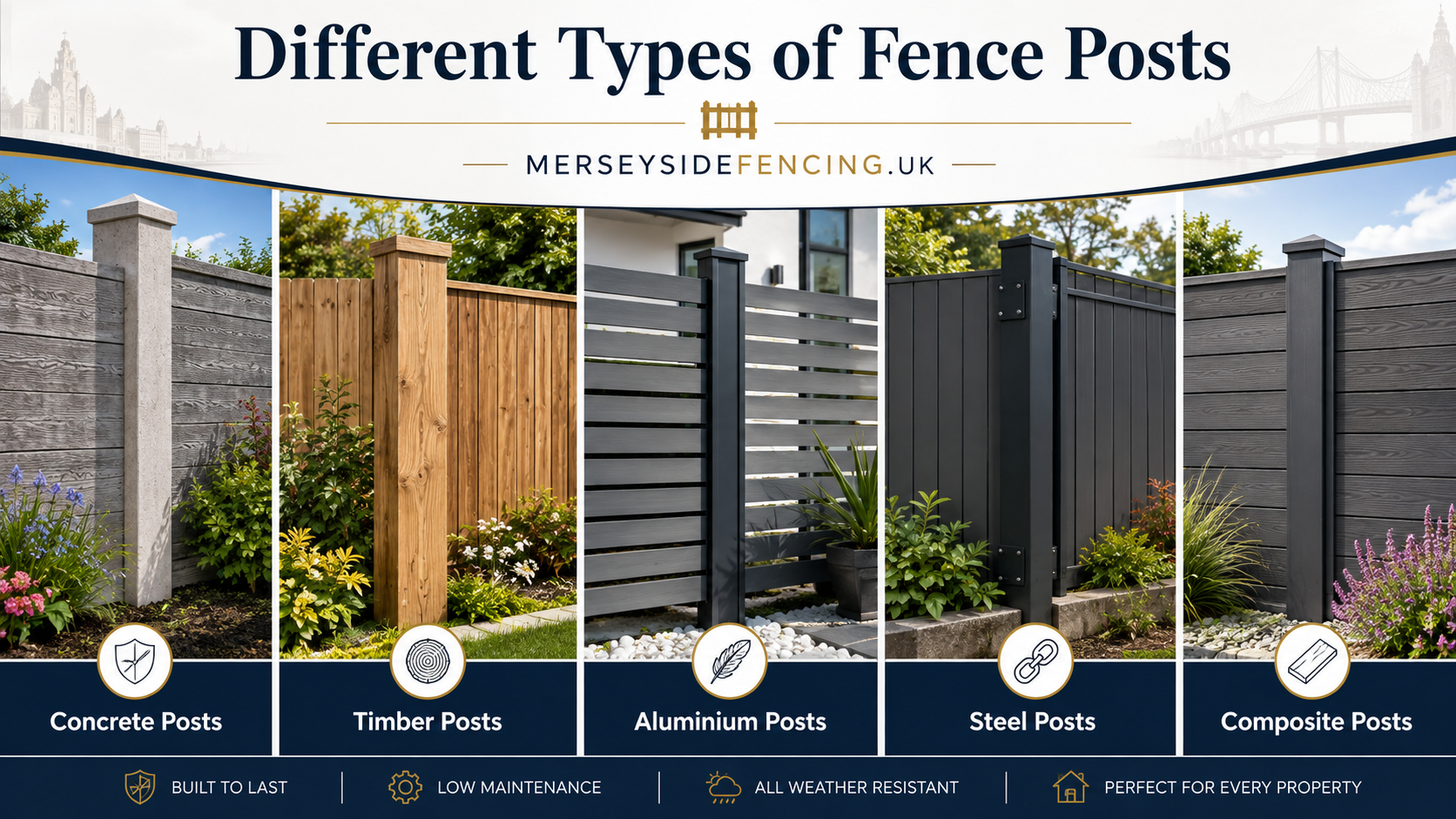
The main options for domestic fencing are concrete, timber, aluminium, composite and steel posts. Each material has advantages and disadvantages, so the right choice will vary from one property to another.
Fence-Post Comparison Table
Post typeMain advantagesMain disadvantagesCommon usesConcreteStrong, rot-resistant and suitable for replaceable panelsHeavy, difficult to install and may crack or chipTraditional panel fencing and concrete gravel-board systemsTimberNatural appearance, adaptable and easy to fix panels toCan decay if inadequately treated or poorly installedCloseboard fencing, timber panels, gates and traditional gardensAluminiumLightweight, corrosion-resistant and modern-lookingHigher initial cost and often system-specificSlatted fencing, decorative fencing and composite systemsCompositeLow maintenance, rot-resistant and colour coordinatedMore expensive and may require internal reinforcementComplete composite fencing systemsSteelStrong, slim, long-lasting and resistant to rotProtective coating must remain intactModern fencing, exposed boundaries and timber-panel systems
Concrete Fence Posts
Concrete posts are widely used throughout Wirral and Merseyside. They are commonly paired with timber fence panels and concrete gravel boards.
Advantages of concrete fence posts
Resistant to rot
Concrete does not suffer from timber decay, making it suitable for damp ground and gardens where the base of the fence is regularly exposed to moisture.
Strong and substantial
Concrete posts provide rigid support for standard fence panels. Their weight can make them a practical option for exposed boundaries, provided they are installed into correctly sized foundations.
Panels can be replaced easily
Slotted concrete posts allow damaged panels to be lifted out and replaced without normally removing the posts. This can reduce future repair work following storm damage.
Compatible with concrete gravel boards
Concrete gravel boards keep timber panels above wet soil and help protect the lower edge from moisture and impact damage.
Disadvantages of concrete fence posts
Very heavy
Concrete posts are difficult to carry and position, particularly where access to the garden is restricted. Installation normally requires more labour than lighter post materials.
Can crack or chip
Concrete is rigid but not flexible. Ground movement, frost, impact damage or poor handling can result in cracks or broken corners.
Less natural appearance
Some homeowners feel that visible concrete posts look too industrial beside timber panels or planted borders.
Panels may rattle
Fence panels can move within concrete slots during windy weather if they are not packed or secured correctly.
Best suited to
Concrete posts are a practical choice for:
- Standard timber fence panels
- Concrete gravel-board installations
- Rear garden boundaries
- Exposed locations
- Homeowners wanting replaceable panels
Timber Fence Posts
Timber posts provide a traditional appearance and blend naturally with wooden panels, gates and garden landscaping.
Their performance depends heavily on timber quality, treatment, dimensions, drainage and installation.
Advantages of timber fence posts
Natural appearance
Timber posts create a consistent look when combined with wooden fencing. They are particularly suitable for traditional properties and gardens with extensive planting.
Easy to handle
Wooden posts are usually lighter than concrete, making them easier to transport through narrow side passages and position during installation.
Easy to customise
Timber can be cut, drilled and shaped using standard tools. This makes it suitable for:
- Sloping gardens
- Stepped fence lines
- Bespoke panels
- Closeboard fencing
- Garden gates
- Trellis and decorative features
Panels can be fixed securely
Panels, rails and boards can be screwed directly to timber posts, creating a solid fence line with less movement.
Simple to repair
Loose rails, minor splits and damaged fixings can often be repaired without replacing the entire fence.
Disadvantages of timber fence posts
Can decay
Timber installed in the ground is constantly exposed to moisture. Posts that are inadequately treated, poorly drained or installed incorrectly may eventually rot around ground level.
Requires suitable treatment
Posts should be pressure treated and designed for ground contact. A light surface coating is not a substitute for appropriate timber treatment.
Natural movement
Wood can expand, contract, split or develop surface checks as moisture levels change. These changes are often cosmetic, but they may be undesirable where a perfectly uniform finish is required.
May require maintenance
Depending on the product and desired appearance, timber may need staining, painting or treatment during its service life.
Best suited to
Timber posts are often chosen for:
- Closeboard and feather-edge fencing
- Traditional timber panels
- Garden gates
- Custom fence designs
- Natural-looking gardens
- Sloping or stepped boundaries
Aluminium Fence Posts
Aluminium posts are commonly used with contemporary fencing, horizontal slats and composite boards.
They provide a clean appearance while remaining much lighter than concrete.
Advantages of aluminium fence posts
Corrosion-resistant
Aluminium does not rust in the same way as ordinary steel. Quality posts are often powder coated to provide additional protection and a consistent finish.
Lightweight
Aluminium posts are easier to carry, position and install than concrete. This can be especially helpful where access is limited.
Modern appearance
Aluminium provides a slim, neat profile and is commonly available in colours such as:
- Anthracite grey
- Black
- Brown
- Silver
- Colour-matched finishes
Low maintenance
Aluminium does not require timber preservative, stain or paint. It generally only needs occasional cleaning and inspection.
Suitable for surface-mounted systems
Some aluminium posts can be installed using base plates on appropriate concrete foundations or structural surfaces.
Disadvantages of aluminium fence posts
Higher initial price
Aluminium fencing systems often cost more upfront than basic timber or standard concrete installations.
System compatibility
Channels, boards, post caps and fixings may be specific to one manufacturer. Components from different systems are not always interchangeable.
Coating can be damaged
Deep scratches or impacts can mark the powder-coated finish. Care is required during transportation, cutting and installation.
Strength varies between products
Not every aluminium post is designed for the same fence height or wind load. Wall thickness, dimensions and fixing methods must be suitable for the proposed installation.
Best suited to
Aluminium posts work well for:
- Contemporary gardens
- Horizontal slatted fencing
- Composite boards
- Low-maintenance installations
- Modern grey or black fencing systems
- Gardens where access is restricted
Composite Fence Posts
Composite posts are engineered products usually made from a mixture of wood fibres and plastic polymers. Some systems also include aluminium or steel reinforcement.
They are most commonly used as part of a complete composite fencing system.
Advantages of composite fence posts
Low maintenance
Composite posts generally do not need painting, staining or preservative treatment.
Resistant to rot
Composite materials are not affected by fungal decay in the same way as untreated or inadequately treated timber.
Coordinated appearance
Posts, boards, caps and trims can be supplied in matching colours, creating a consistent and modern finish.
Resistant to insects and moisture
Composite materials are designed to perform in outdoor conditions without the same risk of insect attack or ground-level timber decay.
Modular installation
Many composite systems use channelled posts into which boards are inserted. This can make it easier to create straight runs, corners and different fence heights.
Disadvantages of composite fence posts
Higher purchase cost
Composite fencing is generally more expensive than entry-level timber fencing.
May require reinforcement
Some composite posts are decorative sleeves rather than fully structural components. They may require internal aluminium or steel supports, especially for taller fences.
Thermal movement
Composite materials expand and contract as temperatures change. Correct installation gaps and manufacturer instructions must be followed.
Difficult to repair
A badly damaged composite component may need replacing rather than repairing.
System-specific parts
Replacement boards, caps and posts may need to come from the original manufacturer.
Best suited to
Composite posts are ideal for:
- Complete composite fencing systems
- Low-maintenance gardens
- Modern properties
- Homeowners wanting coordinated colours
- Rot-resistant fencing
- Contemporary horizontal-board designs
Steel Fence Posts
Steel posts provide a strong alternative to timber and concrete. Modern profiled steel systems can support timber panels, closeboard fencing and composite boards.
Advantages of steel fence posts
High strength
Steel can provide substantial structural support while maintaining a slimmer profile than concrete.
Resistant to rot
Steel is not affected by fungal decay or insect damage.
Lighter than concrete
Although strong, many steel post systems are significantly easier to handle than concrete posts.
Neat appearance
Powder-coated steel posts are available in modern colours and can create a clean, coordinated finish.
Suitable for exposed locations
A properly specified steel fencing system can perform well in windy or open gardens, provided the foundations, panel design and post spacing are appropriate.
Works with different fencing styles
Depending on the system, steel posts can be used with:
- Standard timber panels
- Closeboard fencing
- Composite boards
- Gravel boards
- Decorative screens
- Matching gates
Disadvantages of steel fence posts
Requires corrosion protection
Bare steel can rust. Outdoor posts should be galvanised, coated or otherwise protected for exterior use.
Scratches require attention
Deep damage to the protective coating may expose the underlying metal and should be treated according to the manufacturer’s instructions.
Higher initial cost than basic timber
Steel posts generally cost more than entry-level wooden posts, although their strength and reduced maintenance may provide better long-term value.
Accessories may be proprietary
Some steel systems require specific clips, rails, capping pieces and gravel boards.
Best suited to
Steel posts are a strong option for:
- Exposed or windy gardens
- Modern fencing installations
- Homeowners wanting slimmer posts
- Timber panels supported by metal posts
- Low-maintenance boundaries
- Long fence runs requiring consistent support
Which Fence Post Is Best for a Windy Garden?
No material is automatically storm-proof. Wind resistance depends on the complete fence design, including:
- Post size and thickness
- Foundation depth and width
- Fence height
- Post spacing
- Panel weight
- Whether the panels are solid or slatted
- Ground conditions
- Gate positions
- Corners and changes in direction
- Exposure to prevailing winds
Solid panels catch more wind than open slatted or hit-and-miss fencing. Taller fences also place greater pressure on the posts and foundations.
For exposed properties, steel, concrete or appropriately reinforced aluminium systems may be considered, but professional site assessment and correct installation remain essential.
Which Fence Posts Need the Least Maintenance?
The lowest-maintenance options are generally:
- Concrete
- Aluminium
- Properly protected steel
- Composite
Timber can also provide a long service life when it is correctly pressure treated, properly installed and kept free from standing water.
Even low-maintenance fencing should be inspected occasionally for:
- Leaning posts
- Loose fixings
- Ground movement
- Cracked foundations
- Damaged coatings
- Vegetation trapping moisture
- Impact damage
- Soil built up against posts or gravel boards
Which Fence Posts Offer the Best Value?
The cheapest post is not always the best-value option. Consider the complete cost over the life of the fence, including:
- Purchase price
- Installation labour
- Access requirements
- Future treatment
- Panel replacement
- Post replacement
- Repairs
- Disposal
- Product guarantees
Timber can offer excellent value where a natural appearance and adaptability are important. Concrete remains practical for replaceable fence panels. Steel, aluminium and composite systems may suit homeowners who prioritise modern styling and reduced maintenance.
Professional Fence Installation Across Wirral and Merseyside
Merseyside Fencing supplies, installs and repairs a wide range of garden fencing systems.
We can assess your garden, boundary layout, wind exposure, ground conditions and preferred style before recommending suitable posts and panels.
Whether you are considering traditional timber fencing, concrete posts, modern steel systems or low-maintenance composite fencing, professional installation helps ensure the complete fence is secure, level and built for the conditions.
Contact Merseyside Fencing for a free, no-obligation quotation.
Telephone: 0151 271 7131
Website: merseysidefencing.uk
This article provides general guidance. Product specifications, guarantees and installation requirements vary between manufacturers and individual sites.