Best Timber Garden Fence in Wirral: Waney, Panels or Rail and Board?
Here is a long-form, locally targeted article for a Wirral landscaping or fencing website.
Which Is the Best Timber Garden Fence: Waney Lap, Fence Panels or Rail and Board?
Choosing the best timber garden fence is not simply a matter of selecting the cheapest panel at the builders’ merchant. Your fence must provide privacy, define your boundary and complement your garden, but it also needs to withstand years of rain, wind and changing temperatures.
For homeowners across Wirral, including Birkenhead, Bebington, Bromborough, Heswall, West Kirby, Hoylake, Moreton, Wallasey and New Brighton, selecting the correct fencing system can make the difference between a boundary that needs frequent repairs and one that remains strong and attractive for many years.
Three options are commonly considered:
- Waney lap or overlap fence panels
- Heavy-duty closeboard fence panels
- Traditional rail-and-board or site-built closeboard fencing
Each has advantages, and the best choice will depend on your budget, the location of your garden, the level of privacy required and how long you expect the fence to last.
What Is the Best Timber Garden Fence?
For most homeowners looking for the strongest and most durable timber garden fence, properly installed rail-and-board fencing is usually the best overall option.
Rail-and-board fencing is built in position using posts, horizontal rails and individual vertical feather-edge boards. Because it is constructed as a continuous fence rather than installed as separate six-foot panels, it can be adapted to the exact shape, gradient and dimensions of a garden.
A good rail-and-board fence generally offers:
- Excellent strength and stability
- Greater resistance to movement
- Good privacy and security
- Easier individual board replacement
- A neat, traditional appearance
- Better adaptability on sloping or uneven gardens
- A potentially longer working life when installed correctly
However, rail-and-board fencing normally costs more to install than basic waney panels because it requires additional materials and more labour.
For homeowners working with a limited budget, waney lap panels may still be perfectly suitable. Heavy-duty closeboard panels provide a useful middle ground between low-cost waney fencing and a fully site-built rail-and-board fence.
Understanding the Different Types of Timber Fencing
Before comparing the options, it is important to clarify the terminology.
Waney lap is already a type of fence panel. Therefore, a comparison between “waney, panel, or rail and board” is more accurately described as a comparison between:
- Lightweight waney lap panels
- Stronger pre-manufactured closeboard or feather-edge panels
- Traditional rail-and-board fencing built on site
The correct choice depends on what you need the fence to accomplish.
What Is a Waney Lap Fence?
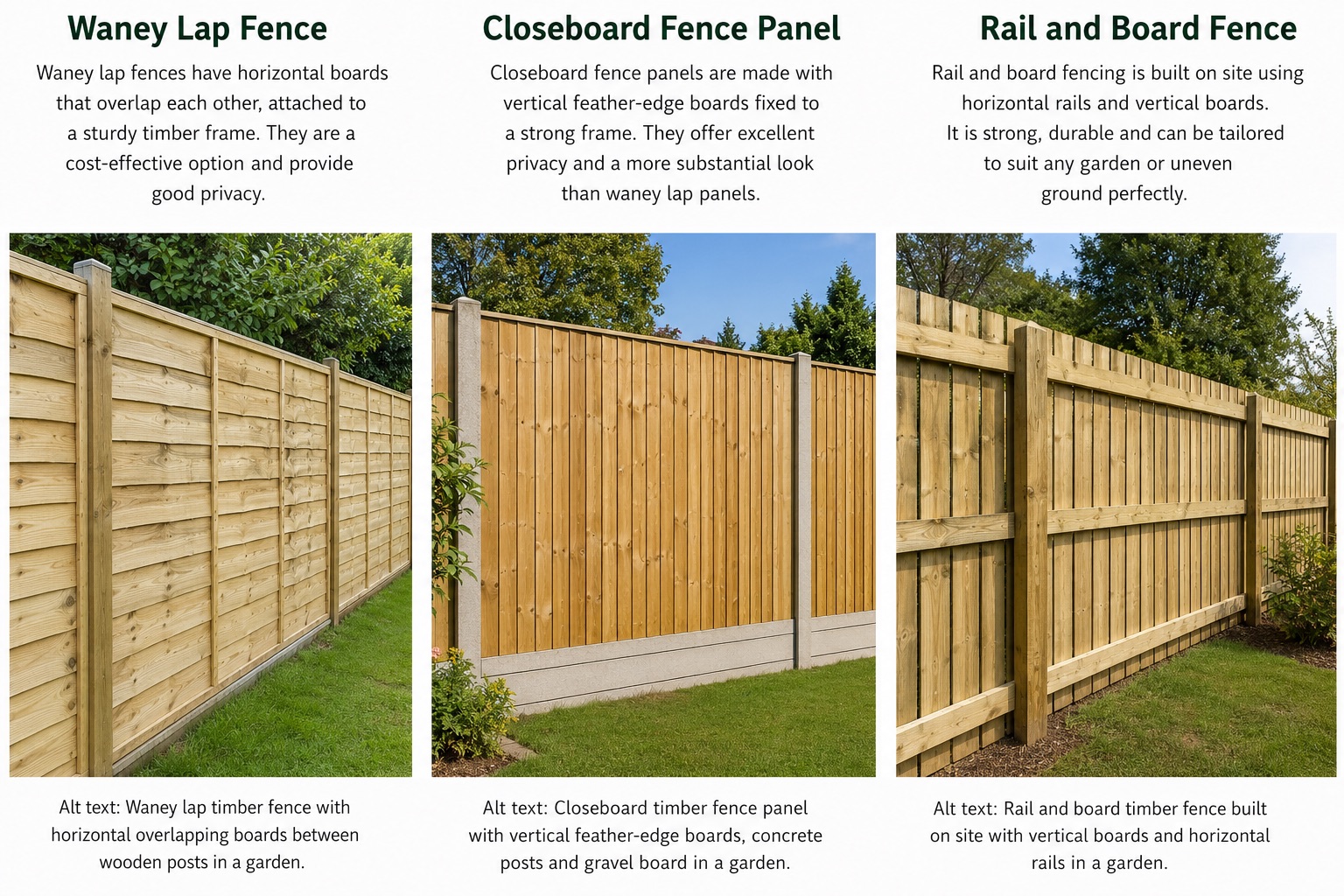
A waney lap fence, also known as an overlap fence, lap panel or larch lap fence, is made from horizontal timber boards that overlap one another. These boards are attached to a relatively lightweight timber frame to create a complete panel.
Most domestic waney lap panels are manufactured in standard widths and are placed between timber or concrete fence posts. The overlapping construction provides privacy while helping rainwater run down the surface instead of collecting on horizontal edges.
Waney lap panels are among the most recognisable garden fence panels in the UK. They are frequently used in rental properties, starter homes, new garden projects and locations where keeping the initial cost down is the main priority.
Advantages of Waney Lap Fencing
The main advantage of waney lap fencing is affordability. It is generally one of the least expensive ways to create a private timber garden boundary.
Because the panels are pre-manufactured, installation can also be relatively quick. Once the posts and gravel boards are in position, each panel can be lifted or slotted into place.
Waney panels offer:
- A low initial purchase price
- Good privacy for the cost
- Quick installation
- Easy availability in standard sizes
- A traditional timber appearance
- Straightforward panel replacement
If one panel becomes badly damaged, it can usually be removed and replaced without rebuilding the entire fence.
Disadvantages of Waney Lap Fencing
The relatively light construction that makes waney fencing affordable can also be its main weakness.
Lower-cost panels may contain thin boards and light framing. Over time, the panel can twist, bow or separate, particularly if it is frequently exposed to strong winds or prolonged damp conditions.
Waney panels are usually less robust than closeboard panels or site-built rail-and-board fencing. The complete panel also acts as one large surface, so the posts, fixings and frame must absorb the force placed on it during windy weather.
Potential disadvantages include:
- Lighter construction
- Greater risk of bowing or twisting
- Shorter service life than heavier fencing systems
- Less suitable for highly exposed boundaries
- Limited flexibility on steep or irregular ground
- The need to replace a complete panel when the frame fails
A high-quality, pressure-treated waney panel installed between strong posts can still perform well. Problems are more likely when the cheapest available panels are combined with undersized posts, no gravel boards or poor installation.
When Is Waney Lap Fencing the Best Choice?
Waney lap fencing may be the best option when:
- You need an economical garden boundary
- The garden is reasonably sheltered
- You want the work completed quickly
- You are replacing panels within an existing panel system
- You do not require a premium decorative finish
- The property is rented or being prepared for sale
- You expect to redesign the garden in the future
For sheltered residential gardens in areas such as Bebington, Prenton, Pensby or parts of Birkenhead, good-quality waney panels may provide an effective and affordable solution.
For a more exposed garden, choosing thicker, pressure-treated panels and strong posts becomes especially important.
What Are Closeboard Fence Panels?
Closeboard fence panels are pre-manufactured panels made using vertical feather-edge boards. Each board overlaps the one beside it and is attached to a heavier supporting frame.
These are sometimes called feather-edge panels, although traditional feather-edge fencing is often built directly onto rails rather than supplied as a complete panel.
Closeboard panels are generally heavier and more substantial than basic waney lap panels. They provide the convenience of a pre-made panel while offering increased strength, privacy and security.
Advantages of Closeboard Fence Panels
Closeboard panels offer a good balance between cost, appearance and durability.
The vertical feather-edge boards create a solid boundary, while the heavier frame helps the panel maintain its shape. They often appear more substantial and more refined than lightweight overlap panels.
Their advantages include:
- Stronger construction than standard waney panels
- Excellent privacy
- A neat and uniform appearance
- Faster installation than site-built fencing
- Good security for domestic gardens
- Easy replacement within a panel-and-post system
- Compatibility with concrete posts and gravel boards
For many Wirral homeowners, a closeboard panel is the most practical compromise. It costs more than a basic waney panel but normally provides a stronger and more attractive result.
Disadvantages of Closeboard Panels
Closeboard panels are considerably heavier than lightweight lap panels. They require sufficiently strong posts, secure foundations and appropriate fixings.
Because they are still complete panels, damage to the supporting frame may mean replacing the whole section rather than one or two boards.
Their standard dimensions can also make them less convenient on sloping ground. The installer may need to step each panel, create custom-sized sections or leave varying gaps beneath the fence.
Potential disadvantages include:
- Higher cost than waney lap panels
- Greater weight
- Stronger posts and foundations may be required
- Less flexible than site-built fencing
- Whole-panel replacement may be necessary
- Standard panel sizes can be awkward in unusual gardens
When Are Closeboard Panels the Best Choice?
Closeboard panels are a strong option when:
- You want more durability than waney fencing
- You prefer the convenience of replaceable panels
- Privacy and security are important
- Your garden is relatively level
- You want a traditional feather-edge appearance
- Your budget does not extend to a fully built-on-site fence
They can work particularly well in suburban gardens throughout Bromborough, Eastham, Greasby, Moreton, Upton, Wallasey and surrounding Wirral areas.
What Is Rail-and-Board Fencing?
Rail-and-board fencing is constructed directly along the boundary.
The system normally consists of:
- Timber or concrete fence posts
- Horizontal timber arris rails or rectangular rails
- A gravel board at ground level
- Individual vertical feather-edge boards
- A capping or counter rail where required
The rails are secured between the posts, and the feather-edge boards are then fixed individually to the rails with a consistent overlap.
The result is often known as traditional closeboard fencing, feather-edge fencing or built-on-site fencing.
Why Is Rail-and-Board Fencing Usually the Best Option?
A professionally installed rail-and-board fence is often considered the best timber garden fence because the complete structure works as one continuous boundary.
Unlike panel fencing, it is not restricted to standard six-foot sections. Post spacing, board height and ground clearance can be adjusted to suit the individual garden.
1. It Is Strong and Substantial
A well-built rail-and-board fence uses multiple rails and individual boards attached across the full fence run.
The strength does not depend on the lightweight outer frame of a pre-manufactured panel. The boards are supported directly by the rails, and the rails are secured to properly installed posts.
This produces a solid and substantial boundary suitable for gardens where durability is a priority.
2. It Can Follow Sloping Ground
Many gardens across Wirral are not perfectly level. Some have gradual changes in height, while others include retaining walls, raised patios or sloping lawns.
Site-built fencing can follow the ground more naturally. The boards can be installed at individually adjusted heights, stepped neatly or cut to suit the boundary.
Pre-made panels are less adaptable because each section has a fixed rectangular shape.
3. Repairs Can Be More Economical
When one feather-edge board becomes split or damaged, that individual board can normally be removed and replaced.
With a panel system, damage to the panel frame can require replacement of the whole section. Individual board repair can therefore make rail-and-board fencing more economical over its lifetime.
4. It Offers Excellent Privacy
The overlapping vertical boards create a continuous screen without the gaps that may appear around poorly fitted panels.
The finished fence can provide excellent privacy for rear gardens, patios, outdoor seating areas, hot tubs and family spaces.
5. It Can Be Built to Fit the Garden
Every boundary is different. There may be corners, gates, sheds, walls, trees, level changes or narrow sections to work around.
Rail-and-board fencing can be measured and constructed specifically for the available space. This often creates a more professional finish than trying to fill an unusual opening with standard-sized panels.
Disadvantages of Rail-and-Board Fencing
Rail-and-board fencing is not automatically the correct choice for every property.
The principal disadvantage is the installation cost. Building the fence board by board takes longer and requires more skilled labour than placing ready-made panels between posts.
It also depends heavily on workmanship. Poorly spaced posts, insufficient board overlap, untreated cut ends, unsuitable nails or weak rails can reduce the fence’s durability.
Possible disadvantages include:
- Higher initial installation cost
- Longer construction time
- More labour-intensive installation
- Greater dependence on installer skill
- More individual components to specify
- Less convenient if the homeowner regularly wants to remove full sections
Despite the higher initial cost, many homeowners select rail-and-board fencing because they value long-term strength and repairability.
Waney vs Closeboard Panels vs Rail and Board: Quick Comparison
FeatureWaney Lap PanelsCloseboard PanelsRail and BoardInitial costLowestMediumHighestStrengthBasic to moderateGoodVery goodPrivacyGoodVery goodExcellentSuitability for exposed gardensLimited with lightweight panelsGood when properly supportedOften the strongest optionSpeed of installationFastFastSlowerSuitability for slopesLimitedLimited to moderateExcellentEase of replacing a sectionEasyEasy but heavyIndividual boards can be replacedAppearanceSimple and traditionalStrong and uniformBespoke and professionalExpected maintenanceModerateModerateModerateBest useBudget fencingStrong panel systemLong-term premium boundary
The quality of the materials and installation remains more important than the name of the fencing style. A poorly installed rail-and-board fence can fail before a correctly installed, high-quality panel system.
Which Fence Is Best for Windy or Exposed Gardens?
Exposed gardens require careful planning. This may be especially relevant in coastal and open locations around West Kirby, Hoylake, Meols, New Brighton and parts of the Wirral peninsula.
The first instinct may be to choose the heaviest solid fence available. However, a solid fence also catches wind, which increases the force transferred to the posts and foundations.
For exposed boundaries, the complete system should be considered:
- Post size and material
- Post depth
- Foundation strength
- Rail dimensions
- Board or panel thickness
- Fixing quality
- Fence height
- Local ground conditions
- The amount of shelter provided by buildings or planting
Rail-and-board fencing can be an excellent choice because it is constructed as a continuous system and can be reinforced appropriately. Heavy-duty closeboard panels installed between concrete posts may also perform well.
Lightweight waney panels are generally less suitable for highly exposed locations unless the products, posts and fixings have been specifically selected for the conditions.
In some very exposed gardens, a partially open or slatted design may place less pressure on the structure than a completely solid privacy fence. This should be assessed for the particular property rather than applying one rule to every garden.
Timber Posts or Concrete Fence Posts?
The posts often determine how well a fence performs.
Timber Fence Posts
Timber posts produce a natural, continuous appearance and can be easier to work with during installation. Rails, clips and boards can be fixed directly to them.
However, the area close to ground level is vulnerable because it is repeatedly exposed to moisture. Timber intended for ground contact should have the correct preservative treatment. UK timber-industry guidance promotes Use Class 4 treatment for timber used in or close to the ground, including structural fencing components. (TDCA)
Ask the installer or supplier whether the posts are suitable for ground contact rather than assuming that all “treated timber” provides the same level of protection.
Concrete Fence Posts
Concrete posts do not rot and are frequently combined with concrete gravel boards. They can provide a robust, relatively low-maintenance supporting system.
Slotted concrete posts also make panel replacement straightforward because damaged panels can be lifted out and replaced.
Their disadvantages include additional weight, a more industrial appearance and the physical work involved in installation.
Concrete posts are particularly popular with waney and closeboard panel systems. Traditional rail-and-board fencing can also be installed with concrete posts using suitable fittings and recessed post designs.
Why Gravel Boards Matter
Regardless of the style selected, the timber should not sit continuously against damp soil.
A gravel board creates a barrier between the fence and the ground. It helps prevent soil, leaves and standing moisture from remaining against the lower edge of the panel or feather-edge boards.
Gravel boards may be manufactured from timber or concrete.
Concrete gravel boards provide strong protection and do not rot. Treated timber gravel boards offer a softer, more natural appearance but will eventually require inspection and possible replacement.
Using a suitable gravel board can help extend the useful life of waney panels, closeboard panels and rail-and-board fencing.
Pressure-Treated or Dip-Treated Timber?
Pressure treatment forces preservative into the timber rather than applying protection only to the outer surface. The Forestry Commission describes pressure treatment—often called tanalisation—as a process that drives preservative into the wood fibres to help protect against decay, insects and fungal attack. (Forestry Commission Blog)
Dip treatment generally provides more limited surface protection. Dip-treated fencing may require earlier and more frequent application of a suitable exterior treatment.
When obtaining a garden fencing quotation, ask:
- Is the timber pressure treated or dip treated?
- Are the posts treated for ground contact?
- What treatment applies to the rails?
- Are cut ends treated during installation?
- Is there a manufacturer’s treatment guarantee?
- What maintenance is required to keep the guarantee valid?
A high-quality timber specification is one of the most important factors in determining the long-term performance of a fence.
How Long Should a Timber Garden Fence Last?
There is no single guaranteed lifespan for every timber fence.
Longevity depends on:
- Timber species and grade
- Preservative treatment
- Ground-contact rating
- Quality of the posts and rails
- Installation depth
- Local drainage
- Wind exposure
- Fence height
- Use of gravel boards
- Fixings and nails
- Ongoing maintenance
- Nearby plants and soil levels
A fence installed in well-drained, sheltered conditions may last significantly longer than an identical product installed in waterlogged ground or an exposed location.
Industry buying guides commonly describe quality pressure-treated panels as products that can provide many years of service when correctly installed, while site-built feather-edge fencing is often selected for longer-term boundary projects. (Walford Timber Ltd)
It is better to examine the material specification, treatment, posts and installation method than to rely on a broad lifespan claim.
Which Fence Requires the Least Maintenance?
All timber fencing benefits from periodic inspection.
A sensible maintenance routine includes:
- Checking for loose boards or fixings
- Clearing soil and leaves from the base
- Inspecting posts for movement
- Ensuring plants are not trapping moisture
- Treating exposed cut ends
- Reapplying an appropriate finish when required
- Repairing small faults before they become structural problems
Pressure-treated fencing may not need immediate painting or staining for protection, although a suitable decorative finish can help preserve its appearance.
Concrete posts and gravel boards can reduce maintenance around the base, but the timber panels or boards will still need occasional inspection.
Rail-and-board fencing has a particular maintenance advantage because individual damaged boards can normally be replaced without removing an entire section.
Which Timber Fence Is Best for Dogs?
For dog owners, a fence must be secure as well as attractive.
Rail-and-board and closeboard fencing both create solid boundaries with minimal visibility through the boards. This can help reduce opportunities for dogs to squeeze through gaps or become distracted by movement outside the garden.
When installing a dog-friendly fence, consider:
- The adult size and jumping ability of the dog
- Gaps below the fence
- Weak areas around gates
- Spaces beside sheds and outbuildings
- Whether the dog digs
- The security of latches
- Sharp or exposed fixings
- The condition of the bottom boards
Rail-and-board fencing is particularly useful when the bottom edge must follow uneven ground. Individual boards can be adjusted to reduce escape gaps without leaving an entire panel at an awkward angle.
No timber fence should be described as completely escape-proof without considering the behaviour and abilities of the individual dog.
Do You Need Planning Permission for a Garden Fence in Wirral?
In England, a fence, wall or gate can usually be installed without planning permission when it does not exceed:
- One metre in height when next to a highway used by vehicles, including the footpath beside it
- Two metres in height elsewhere
A higher fence will normally require planning permission. (Planning Portal)
Different considerations may apply to listed buildings, properties in conservation areas, restrictive planning conditions or locations where permitted development rights have been removed.
Wirral Council directs residents to the Planning Portal for general permitted-development guidance and offers routes for seeking formal confirmation where required. (Wirral Council)
Always check the current rules before replacing a low front boundary with a taller fence or carrying out work around a listed or historically sensitive property.
What Is the Best Fence for a Front Garden?
Front garden fencing usually needs to balance appearance, security and visibility.
A full-height solid privacy fence may look too enclosed for some properties and could be restricted when positioned beside a road or pavement.
Popular front garden options include:
- Low timber rail-and-board fencing
- Picket fencing
- Decorative vertical-board fencing
- Low closeboard fencing with trellis
- Timber fencing combined with planting
- Short panels between brick pillars
The style should complement the architecture of the property and the character of the street.
For areas such as Port Sunlight or conservation-sensitive parts of Wirral, checking the relevant planning and heritage requirements before altering a prominent boundary is particularly important.
What Is the Best Fence for a Back Garden?
For most back gardens, privacy, durability and security are the primary considerations.
A six-foot closeboard or rail-and-board fence is a common choice because it creates a solid screen. Waney panels can provide similar privacy at a lower initial cost but may not offer the same strength or refined appearance.
For a long-term home improvement project, rail-and-board fencing is usually the strongest recommendation.
For a practical, good-quality panel system, closeboard panels are often the best balance.
For an economical repair or straightforward boundary, waney lap panels remain a useful option.
Should You Repair or Replace an Existing Fence?
A complete replacement may not be necessary when:
- Only one or two panels are damaged
- The posts remain solid and upright
- The gravel boards are sound
- The rails have not failed
- The boundary line is correct
- The remaining timber is in reasonable condition
Replacement may offer better value when:
- Several posts are moving or rotten
- Panels are repeatedly blowing down
- The fence has extensive decay
- The structure is leaning
- The current fence does not provide adequate privacy
- There are unsafe nails, broken boards or unstable sections
- Previous repairs have created an inconsistent boundary
A professional inspection can identify whether the visible damage is limited to a panel or caused by a failing post and foundation.
Final Verdict: Waney, Closeboard Panel or Rail and Board?
There is no single fencing product that is best for every garden, but the following recommendations apply in most situations.
Choose Waney Lap Panels When:
Your priority is keeping the initial cost low, the garden is reasonably sheltered and you need a straightforward private boundary.
Choose Closeboard Fence Panels When:
You want a stronger and more substantial panel than waney lap, but still value quick installation and easy panel replacement.
Choose Rail-and-Board Fencing When:
You want the strongest overall timber fencing option, a bespoke fit, excellent privacy and the ability to repair individual boards.
For most permanent residential boundaries, rail-and-board fencing is the best long-term choice. It is particularly suitable for uneven ground, awkward garden shapes and homeowners seeking a substantial, professional result.
A high-quality closeboard panel system is the best all-round alternative when speed and replaceable sections are important.
Waney fencing remains the best budget choice, provided the panels are good quality and supported by correctly installed posts and gravel boards.
Professional Garden Fencing Across Wirral
The best timber garden fence is only as good as its installation.
Correct post spacing, foundations, timber treatment, rails, fixings and ground clearance all affect how the finished fence performs. Before choosing solely on price, compare the complete specification and ask exactly what materials are included.
For advice about garden fencing, landscaping and outdoor improvements in Wirral, contact the team at Artificial Grass Wirral.
Visit www.artificialgrasswirral.com or call 0151 606 9523 to discuss your garden project and request a quotation.
Frequently Asked Questions
Is waney fencing the cheapest option?
Waney lap is normally one of the most economical solid timber fencing options. The final installation cost will also depend on the posts, gravel boards, disposal, access and condition of the ground.
Is rail-and-board fencing stronger than panels?
A properly specified and professionally installed rail-and-board fence is generally more substantial than a lightweight panel system. It is built as a continuous boundary and can be adapted to the garden.
Are closeboard panels better than waney panels?
Closeboard panels are normally heavier and stronger than basic waney panels. They are a good choice for homeowners who want improved durability without paying for a fully site-built fence.
What fence is best for a sloping garden?
Rail-and-board fencing is usually the best choice for a slope because individual boards can be adjusted to follow or step with the ground.
Are concrete posts better than timber posts?
Concrete posts will not rot and can provide a durable supporting structure. Timber posts provide a more natural appearance and are easier to fix into, but they must have the correct treatment for their intended use.
Can I install a two-metre fence without planning permission?
A fence up to two metres high can usually be installed without planning permission when it is not beside a highway. Beside a highway used by vehicles, the usual limit is one metre. Additional restrictions can apply, so check the current position for your property before starting work. (Planning Portal)
Which fence is best for privacy?
Closeboard panels and rail-and-board fencing both provide excellent privacy because the feather-edge boards overlap to create a solid screen.
What timber treatment should fence posts have?
Timber posts installed in the ground should be specified for ground contact. Look for fencing posts treated to Use Class 4 or an equivalent appropriate specification. (TDCA)
Suggested SEO title:
Best Timber Garden Fence in Wirral: Waney, Panels or Rail and Board?
Suggested meta description:
Which timber garden fence is best for your Wirral property? Compare waney lap, closeboard panels and rail-and-board fencing for cost, strength, privacy and durability.
Suggested URL slug:/best-timber-garden-fence-wirral
Primary target keyword:
best timber garden fence Wirral
Supporting keywords:
timber fencing Wirral, garden fence panels Wirral, waney lap fencing, closeboard fence panels, rail and board fencing, feather-edge fencing Wirral, garden fencing contractors Wirral, wooden fencing Merseyside
The article can be adapted into separate service-area versions for Birkenhead, Heswall, West Kirby, Wallasey or Bromborough without duplicating the main copy.